
OU MFA Thesis Exhibition 2026
Friday, April 10, 2026 through Friday, April 17, 2026
Opening Reception: 6-9 p.m. Friday, April 10
Artist Statements
-
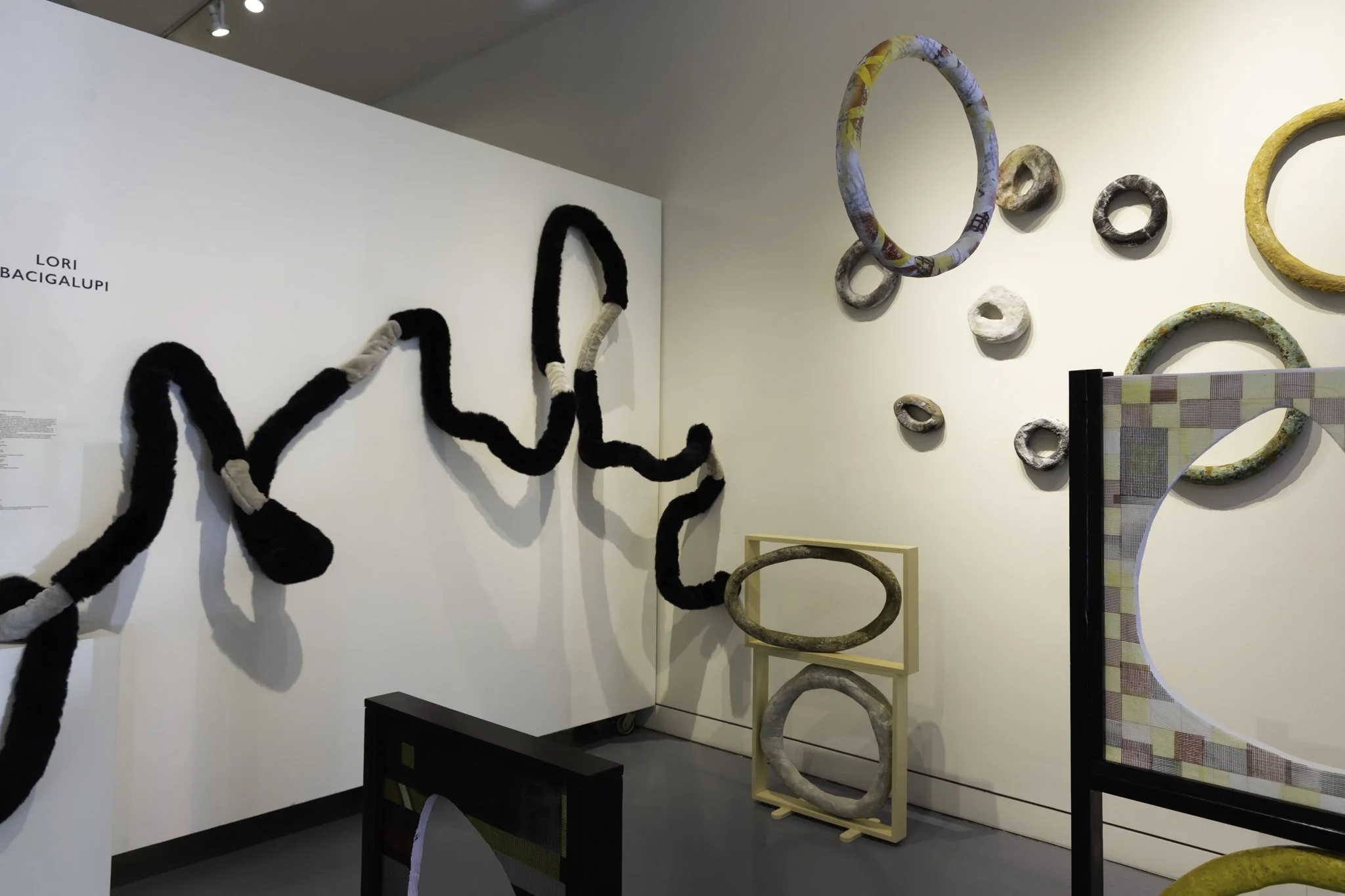
I can relate to the term “mind squinting”.
In my mind’s eye I see an idea from a distance, slightly out of focus and incomplete.
The important elements are there. I already have a concept which may have been inspired by a conversation, film, book or life event. I live in two worlds. The physical world is no less significant to me than my inner world. I’m connected to the birds and trees as much as with other humans. The separations for me can’t be trusted. I am aware of the importance of my journey, and value this precious joy filled and painful life.
Conceptual artist Lygia Clark was an inspiration for my thesis work. Her notion that “Line Is Space” is the focus of my thesis collection. I am always seeking to know my own Truth, and to create a visual to share that speaks of the evasive, obscured, and illusionary nature of what is seen.
Materials have been used in non-traditional ways. Space becomes more significant than what’s around it. Perspective is constantly changing and yet, there is a familiarity throughout it all. Relationship between objects alters how we see, and Insight is a breath away.
READING LIST
An Immense World,Ed Yong
The Overstory,Richard Powers
Nothing is True and Everything is Possible, Peter Pomerantsev
The Light Eaters, Zoe Schlanger
The Essential Neruda: Selected poems, Pablo Neruda, Edited by Mark Eisner
-
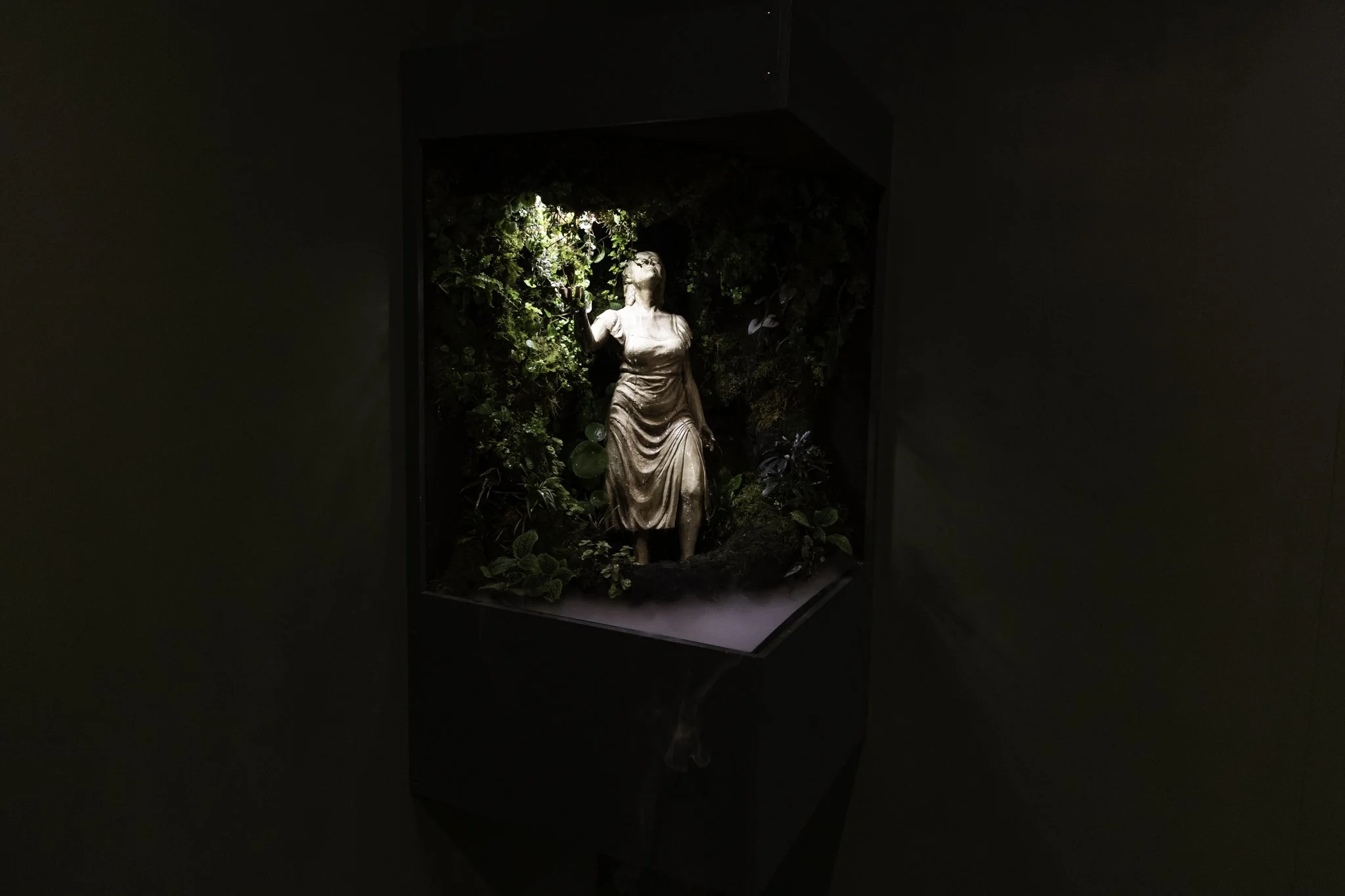
What Grows in the Dark? is an installation that moves through memory, tracing how the body holds experience over time. Through figurative ceramic sculpture and immersive environments, I use botanical forms as a language to explore curiosity, stillness, rupture, and the slow process of living with what remains after hardship.
My work begins in childhood with moments of quiet attention spent outdoors, where I would sit in the grass and pull apart leaves to understand how they were made. These early experiences of touch and observation established a way of knowing rooted in the body. In this space, plants are not symbols but companions, structures to be studied, held, and gently undone.
As the installation unfolds, that sense of calm shifts. Organic growth turns invasive. Surfaces tighten. Forms start to carry tension. Botanical elements that once felt soft and exploratory take on a more invasive presence, reflecting how memory changes under pressure. The body, like a landscape, becomes a site where accumulation occurs and where experiences root, invade, and resist removal. Likewise, the walls of the installation also converge and tighten, pressing the viewer into a contricting space.
In Consumption, the work reaches a point of overwhelm. The figure is overtaken by moss, fungi, and decay, suggesting a loss of boundary between self and environment. This moment is not only about destruction, but about transformation.
What is internal becomes visible and unavoidable.
The final spaces move toward a quieter form of integration. Growth returns, but it is no longer naive. Herbs, stems, and flowers carry a different weight. They feel grounded. Aware. These works do not resolve what came before, but hold it in balance. What emerges is not healing in a conventional sense, but a continued negotiation between memory, body, and environment.
Throughout the installation, I am interested in how stillness operates. Not as emptiness, but as a resonant state that can be felt physically. The spaces are designed to slow the viewer down, encouraging a mode of attention similar to the one that first shaped the work:
Quiet. Close. Embodied.
Ultimately, this exhibition asks what takes root within us, what grows beyond our control, and what it means to live alongside it.
In other words, What Grows in the Dark?
-
“I do not insist that my argument is right in all other respects, but I would contend at all costs both in word and deed as far as I could that we will be better men, braver and less idle, if we believe that one must search for the things one does not know…”
-Socrates (via Plato)
“We are made of ‘ethereal beings’, existing beyond our dimensions of recognized reality. These higher beings are in communication with us, reading our thoughts and sending us messages through celestial symbols which most of us do not even perceive, much less understand. A genius is one who comprehends and channels these messages from higher beings into technologies, products, and even art.”
-Konstantin Tsiolkovsky (founding father of rocketry and aeronautics)
“Through the Force, things you will see, other places. The future, the past, old friends long gone.”
-Yoda (Jedi Master)
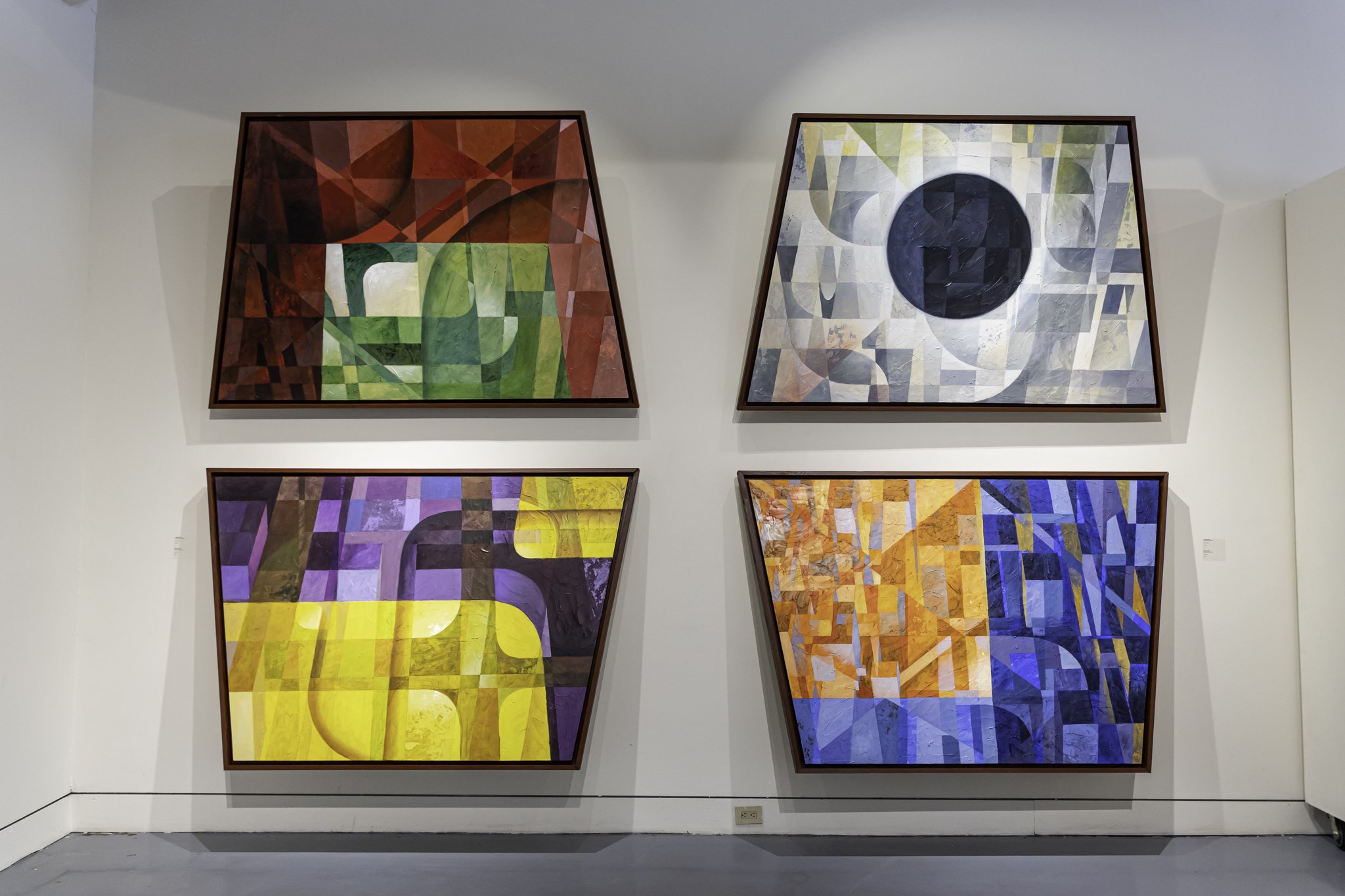
The Skeptic’s Guide… is a body of work that emerges from a deliberate practice of mental and spiritual attunement, drawn from protocols practiced since time immemorial by researchers, inventors, monks and mystics. Practitioners ranging from contemporary NASA researchers, like Timothy Taylor, all the way back to philosophers of antiquity, like Plato. Research for this project included works on plant intelligence, machine learning, UFO religions, and the history of western esotericism. I have spent the last twelve months attempting to rewire my habits, quiet my mind, and open myself to contact with non-human intelligence. Whether that intelligence is alien, machine, divine, psychological, or simply metaphorical remains unresolved.
The works you see here are not documents of contact, but echoes of the process. They are visual thought-forms, shaped in moments of intuitive clarity. This project asks what it means to momentarily step outside of our understanding of the “objective” nature of reality, and into a practice of observing, without expectation, the strange and the sacred.
Ultimately, this work is about attempting to know the unknowable. It is about the nature of human consciousness. It is about learning the discipline to seek the mysteries that flicker just at the edge of perception.
Associated reading list:
American Cosmic, D.W. Pasulka
Encounters, D.W. Pasulka
Ways of Being, James Bridle
Nothing is True and Everything is Possible, Peter Pomerantsev
Machine Vision, Jill Walker Rettberg
The Kybalion, Three Initiates
-
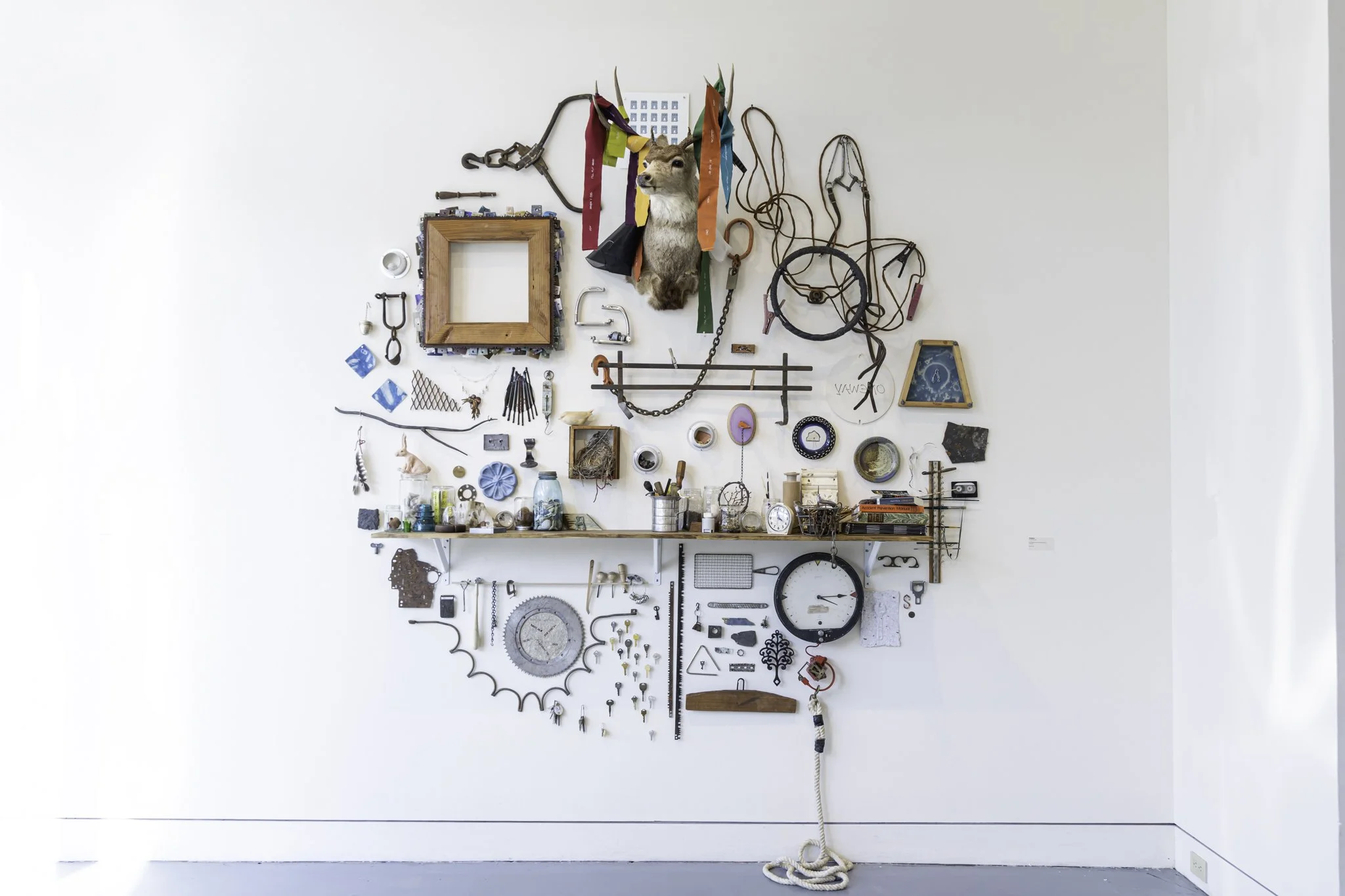
This body of work explores episodic memory and the ways time is experienced through memory as nonlinear, fluid, and constantly re-formed through the act of re-remembering. Objects often serve as catalysts for this process, quietly witnessing our lives in the same way that we witness theirs. Through these relationships, objects invite us into dialogue with the past and with ourselves, prompting questions about belonging, mortality, and what it means to be held within a moment.
My practice is grounded in an understanding that objects have the ability to carry history even after losing their original function. I approach the objects I work with in the same way I approach the people I care for, with the understanding that we are all made up of stories. Even if that story is no longer fully accessible, I aim to help these objects fabricate their histories through the study of their external markers. Many of the materials I use have been discarded or overlooked, existing in a kind of cultural exile. By bringing them into my work, I attempt to collaborate with them, helping to restore a sense of presence while allowing their histories to remain intact.
Embedded within this work are my own personal histories and the inherited stories that shape how I have come to understand my identity. These memories are carried through material and the labor of making, which is often rooted in care, labor, and repetition, ultimately reflecting the ways knowledge is passed down, reinterpreted, and used to shape our lives and the spaces we inhabit.
The process of my practice becomes a form of listening. I attempt to help these objects emerge from the silence imposed upon them when they were discarded, allowing them instead to inhabit a space of quiet presence where new connections and memories can form. These spaces reflect the ways we come to understand ourselves through others, through inherited behaviors, through acts of care, and through the rituals that shape our daily lives. Within this work, memory is not something that is simply recalled, but something that is actively constructed through storytelling, presence, and our relationships to the people and environments that have formed us.
The objects that most often speak to me are those made from materials that share a similar ephemeral quality with the human body: wood, metal, glass, and clay. This situates my work in relation to the land I inhabit and the ways my body moves within it. The objects that collaborate with me carry traces of their origins in the earth while also bearing the marks of human use. In this way, the body, the object, and the land become intertwined, each shaped by time, and each one day falling victim to it. Memory, then, has the ability to extend beyond the individual, becoming something shared, inherited, and continuously transformed.
In response to these objects, I create spaces where viewers can engage in a process of remembering. Each act of remembrance becomes the formation of a new memory layered onto the old. These spaces do not offer resolution, but instead reflect the instability of memory itself, where what is remembered, imagined, and lost begin to blur. These works speak to the act of storytelling that is inherent in helping someone else, or ourselves, remember the things our mind has forgotten. Someone, Something, Somewhere becomes a reflection of this process, where memory is held in fragments rather than in full.
At its core, this work is rooted in the belief that objects are not silent. They are simply waiting for some one to listen.
Reading List:
• Bridle, James. Ways of Being: Animals, Plants, Machines: The Search for a Planetary Intelligence. Picador, 2023.
• Dere, Ekrem. Handbook of Episodic Memory. Elsevier Science, 2008.
• Estés, Clarissa Pinkola. Women Who Run with the Wolves: Myths and Stories of the Wild Woman Archetype. Rider, 1998.
• Macpherson, Fiona, and Fabian Dorsch. Perceptual Imagination and Perceptual Memory. Oxford University Press, 2018.
• Nayebpour, Karam, and Naghmeh Varghaiyan. Storytelling as an Act of Remembering. Episodic Memory in Post-Millennial Irish Narrative. Karam Nayebpour; Naghmeh Varghaiyan. Ibidem-Verlag, 2024.
• Solnit, Rebecca. The Mother of All Questions. Haymarket Books, 2017.
-
Other Times
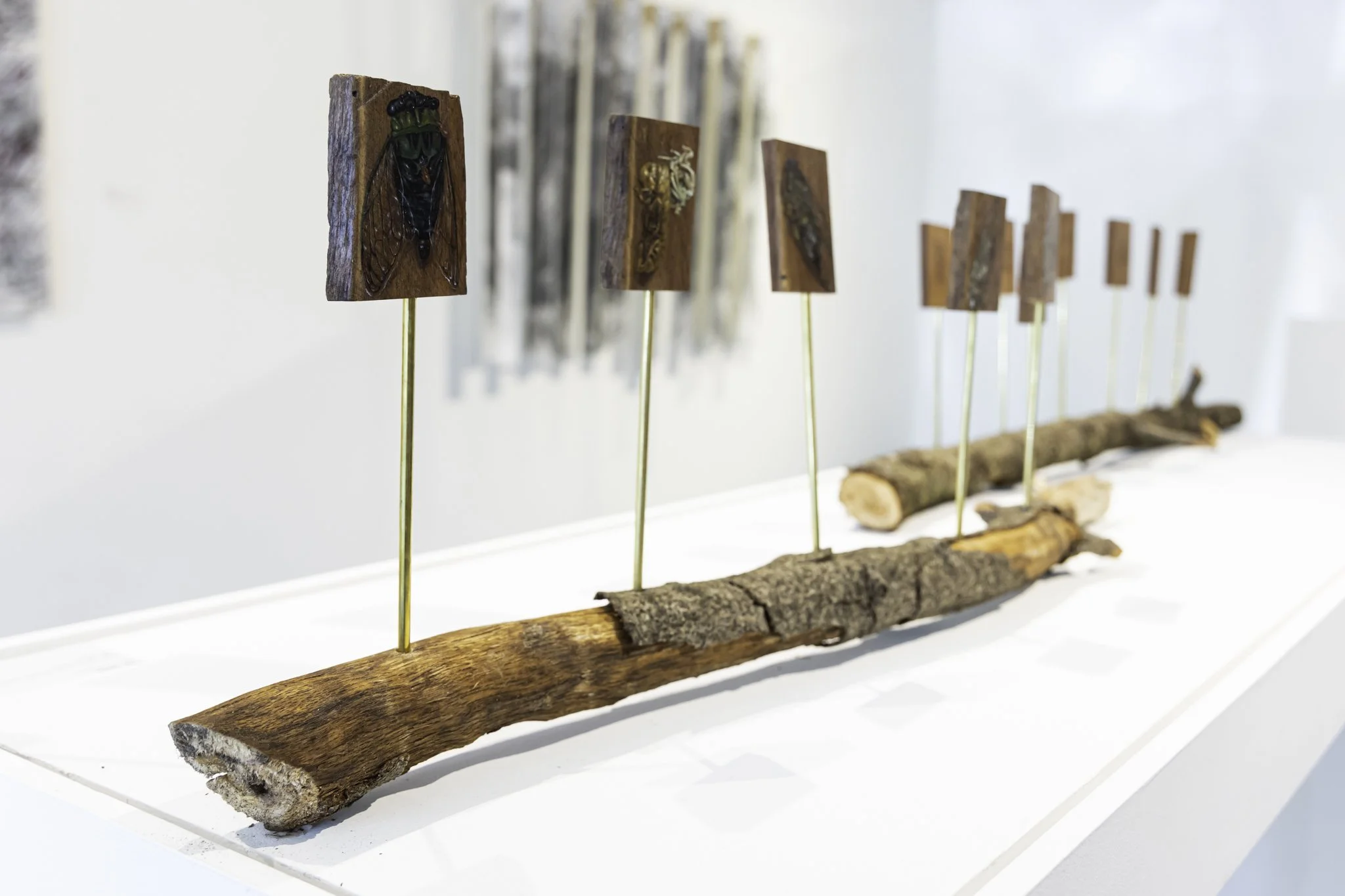
The earth is unfathomably old. It contains remnants of billions of years, compressed through pressure and heat over time into thin layers of geologic matter. Vertically oriented geologic diagrams stack these histories as distinct layers receding down towards the center of the earth; depth equates to age through the law of superposition. Organic bodies trapped in this process occasionally undergo taphonomic alchemy, transforming from biologic to geologic through fossilization. Handling a fossil provides tactile recognition of mortality and fragility, a geologic memento mori; these subterranean remnants warn of entire ecologies dissolved through extinction. In popular culture, depictions of ancient creatures are often alien and anachronistic; panoramas of jutting volcanoes erupt their boiling red smoke into pink skies, where toothy therapods stalk and slash innocent lumbering sauropods. Fantastic ancient natural worlds of darkness and undomesticated chaos buried millions of years below, a world without humans, according to humans.
This work explores the subterranean, the interior, the hidden spaces of time found in nature. It encourages a scale shift and de-orientation, displacing anthropocentrism and linear time as primary perspectives. Images of geologic strata, fossils, cicadas, and tree rings reference re-emergence, where strange, old, buried ecologies protrude into the familiar. Each image is embedded with a superposition of data reflecting shifting climates, dendrochronology, cicada calls, folk murder ballads, and the Ocarina of Time, stacking contemporary personal narrative with alternate chronologies and scales of experience. The horror of increasingly disrupted ecological systems emerges as data and imagery referencing extinctions, ancient and current.
Reading List:
The Order of Time, Carlo Rovelli
Otherlands, Thomas Halliday
Frankenstein, Mary Shelly
Timefulness, Marcia Bjornerud
The Weird and the Eerie, Mark Fisher
Haley Prestifilippo
Lori Bacigalupi
Matthew Gilliland
Emma Moorman
Katherine Gaff